

In Praise of the Nocturnal Home
Being a daughter of the moon, I always seem to find myself holding my breath for the Mid-Autumn festival. This year is no different.
The Mid-Autumn festival is a day in the Chinese calendar where we celebrate the moon. In Chinese philosophy the moon represents – in the natural world – the phenomena of yin: the stillness, the quiet, the reflective, the feminine, the gentle.
So, when we speak of culture being born from place, and of people as a product of environment I often think of the Mid-Autumn festival. The traditions of this time that I hold so dear to my heart, the values of eastern philosophy, and the wisdom the ancient sages that have passed down to us through these festivals, to teach us to live in alignment with the earth: to live well.
When I think of the Mid-Autumn festival, I think of many things.
I think about the reunion of family, of fermented tea and sweet mooncakes. I think of the scent of fresh osmanthus dancing along the chill of the night air.
I think of my family, being wrapped up in a relative’s coat as a child’s small feet pitter patter onto the balcony, and we gaze at the spender of the full moon on this beautiful night. I think of myths and legends of sacrifice and betrayal. I think of the hushed whispers of Changee and her flight, and how we, for thousands of years, from generation to generation have kept her immortal tale alive.
But if you really ask me what the Mid-Autumn festival celebrates; the common thread that weaves it all together: I think of yin. I think of the simple beauty of the night and the pocket of stillness this evening carves out for us.
I believe that the love I have for the Mid-Autumn festival reflects a very eastern aspect of my psyche, upbringing and philosophy of design and life.
Growing up between Shanghai and Melbourne, between east and west, between a city and culture so ancient and one newly emerging I always felt myself stretched between two worlds. My upbringing, a constellation that spans over two lands. The appreciation for the yin of life, I would later discover as I attended architecture school, was a profoundly eastern way of seeing the world.
“In the west our most powerful ally is the light… and for us the act of inhabitation is mostly performed in cahoots with the sun, our staunchest ally, bathing our world or flickering thought it, helping give it light.
It comes with the thrill of the slap for us then to hear praise of shadows and darkness.”
- Charles Moore
School of Architecture, UCLA
In Praise of Shadows is a beautifully composed essay on aesthetics by Japanese novelist Tanizaki, and infamous amongst the undergraduate class of Architecture, as an eastern way of appreciating space: of praising shadows.
And so, perhaps a bit sentimental with the approach of the Mid-Autumn festival, a season of 赏月(shang yue); of gazing and appreciating the moon, and with In Praise of Shadows as my latest beside read (a short novel that can be finished in an afternoon or two), I also would like to bring praise to shadows. To marvel at the yin of life, and to convince whoever may read this, to slow down and find the beauty in the yin.
As written in The Praise of Shadows, the modern world reveres the sun.
We are obsessed with output and the hustle and bustle of life. So much of our adult life is structured around outputs, KPIs, ad feeling like you have done enough, you have achieved enough to deserve rest. I see it in the conversations I have with clients, the constant need to perform, the ways we contort ourselves to avoid stillness and avoid rest. In times like these, in environments like these, it is no wonder we are all constantly restless and burnt out. If only the modern world would embrace the qualities of yin. To have the gentleness of heart to allow ourselves to rest for no reason, with no metric to track, no outcome to fulfill. Except for the simple joy of finding a moment of quiet and appreciating the stillness of the darkness, the nothingness.
To live well in our bodies, we need a balance of yin and yang. Because it is within our nature to reach toward the sun, as all lifeforce does, I think that makes it even more important to remind ourselves to seek the yin. To see when the body and soul are out of balance and bring it back to centre.
As important as it is to take action and to peruse one’s dreams, we must also remember the equal (perhaps even more) important act of allowing oneself to dream. To create the time, space and cultivate the deep love and nourishing of self to allow ourselves to rest.
The yin here which manifests in mind and body can be practical in protecting your peace, setting boundaries, not only with the outside world but also for the expectations you have for yourself. Give yourself enough time and curate the right environments for your nervous system to rest.
Follow the rhythms of nature, as the sun begins to set, so too, do you begin to wind down. Create a routine of easing into stillness, of easing into yin.
To love the yin is also to find comfort in it in our environments. I don’t know when humanity decided that the only acceptable home is one that is constantly bathed in light and visible in all hours of the day (a workplace I understand, as I am reluctant to generalise these spaces as ones that bring happiness and nourishment). From the bright overhead lights that we keep on until its time to sleep, to the sleek white tiling that details every kitchen and bathroom.
Why must our built environment always be in a constant state on yang?
Angel at the Musée d’Orsay’s after dark.
“Modern man in his well-lit home knows nothing of the beauty of gold”1- Tanizaki, In Praise of Shadows
Radical as this idea might sound to a western audience, as a feng shui practitioner I implore you to experience your home in the beauty of its darkness. To see the fragile beauty that would vanish under the harsh glare of the yang hose.
This is not to ask you to go blindly stumbling around your home in the pitch black of night, but rather to allow darkens back into your dwelling, even if only comparatively against before. To turn off your overhead lighting before dinner and let the gentle glow of the fireplace, or soft, warm table lamps illuminate your space in its moment of yin. Give yourself a moment of rest in a nice warm bath (water also belongs to the yin) within the glow of candlelight as you play some music that soothes your nervous system.
You will find your mind and body responding to this too. The yin nourishes a stillness, a restedness. The yin represents an interiority or a mystery, that which cannot be seen. You may find through changing your environment you will be able to hear your internal voice much stronger and find better, deeper communication with the people in your life.
There is a beauty within the home and environment that is only revealed through shadows: The textural softness of place is amplified in the darkens, the long shadow cast by soft lights or the setting of the sun bring an air of mystery and trance to even the most mundane spaces and the sensory expansion of your experience, as your eyes are allowed to rest.
There are many ways I can wax poetic about the nocturnal home, but I believe you need to experience it for yourself to know its true beauty.
The night of the mid-autumn festival is a great ritual of yin.
Of learning to love the moon in all her glory.
Our home should be lived in, her walls should support us in each season of our lives, changing with the transitions of time and space. I have never seen this dynamic – this energetic shift- of the home as well captured as on the night of the Mid-Autumn Festival. If you are unaware of this cultural event, I will briefly explain what each Chinese household does this night in collaboration with the environment.
This is the night where the moon is the fullest and hangs lowest in the sky, therefore each Chinese family is preparing their environment in celebration of the yin. We open our windows and doors to let in the cool night breeze (usually done before it gets too cold). A large warm meal is cooked as families gather around a traditionally round table, mirroring the roundness and the fullness of the moon. Deep into the night our celebrations do not stop here, after dinner lights are turned off, sans for a few small table lights or candles, as a pot of tea is brewed and mooncakes (also made in celebration of the beauty and roundness of the moon) are presented for dessert.
If we can brave the chill of the night everyone moves outside for a moment of quiet, of stillness, of yin as this is the time we gaze at the moon and appreciate its splendour; something impossible to do in the well-lit home. It is only within darkness, within the shadows that festival, that this second most significant Chinese holiday (after the Chinese New Year) can exist.
Should you find yourself at home on the night of September the 25th this year (the date changes each year according to the lunar calenderer) I invite you to include some of these practices into your night and live in the beauty of yin.
As I am writing this piece, I have just returned from a night at the Cartier Jewellery exhibit at the NGV, viewing dazzling gemstones and diamonds adorning the walls and alcoves of this gallery. Under the unforgiving brightness of gallery lights, these gemstones that have defined history and marked many opulent homes of taste of refinement can appear gaudy and overwhelming.
The bring lights spotlighting thousands of glittering diamonds can give one migraine when stared at too intently. As I was moving through the exhibit I couldn’t help but notice home much more beautiful these decorations of the body were when photographed or in painting. Always in the darkens of a palace or aristocratic home, is where the beauty of these gems could truly capture someone.
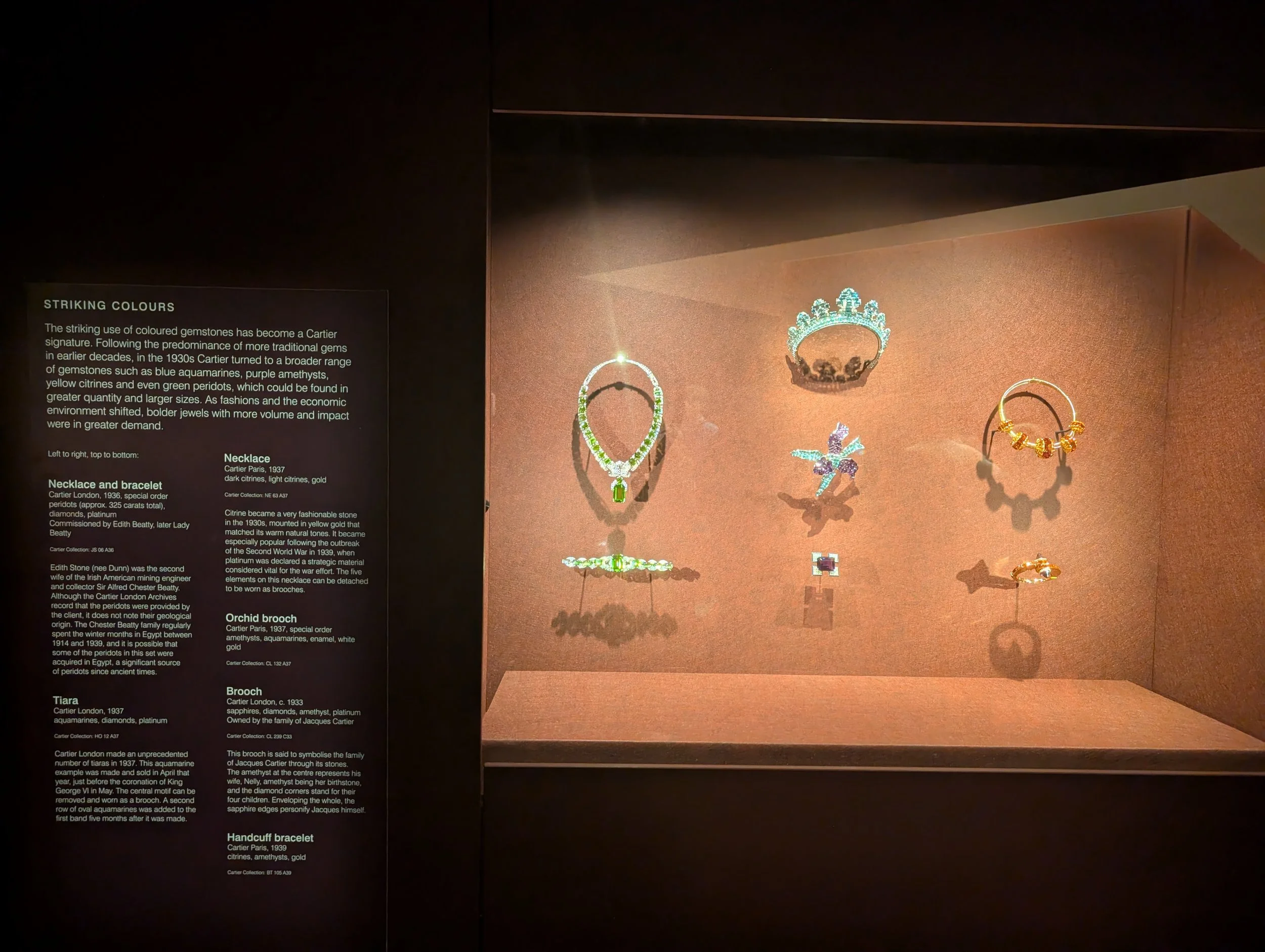
Photo of the Cartier exhibit. Jewels under the harsh spotlight. The constant illumination and shine can evoke feelings of disorientation; pieces of such great craftsmanship can look garish under the light.
“A phosphorescent jewel gives off its glow and colour in the dark and looses its beauty in the light of day. Were it not for shadows there would be no beauty.”
- Tanizaki, In Praise of Shadows
Perhaps you could imagine the golden light of an evening gala. Candlelight and incandescents, scarcely illuminating the night. Gemstones in this environment “which in the moment has only been a dull, sleepy lustre, will, as you move past, suddenly gleam forth as if it had burs into flame”. What a divine encounter indeed?
It is without a question to me that all the most decant jewels that humanity has revered as the epitome of beauty and glamour were made to be seen in the dark. How spellbinding it must be to see this glimmer of divinity within the fold of shadows. Lest we forget, that the yin is the phenomena of the feminine, of our intuition, of seduction and mystery, and also the archetype that relates to beauty.
“The Chinese also love jade. The strange lump of stone within its faintly muddy light, like the crystallisation of air of the centuries, melting dimly, dully back, deeper and deeper – are not we Orientals the only ones who know its charms?”
- Tanizaki, In Praise of Shadows
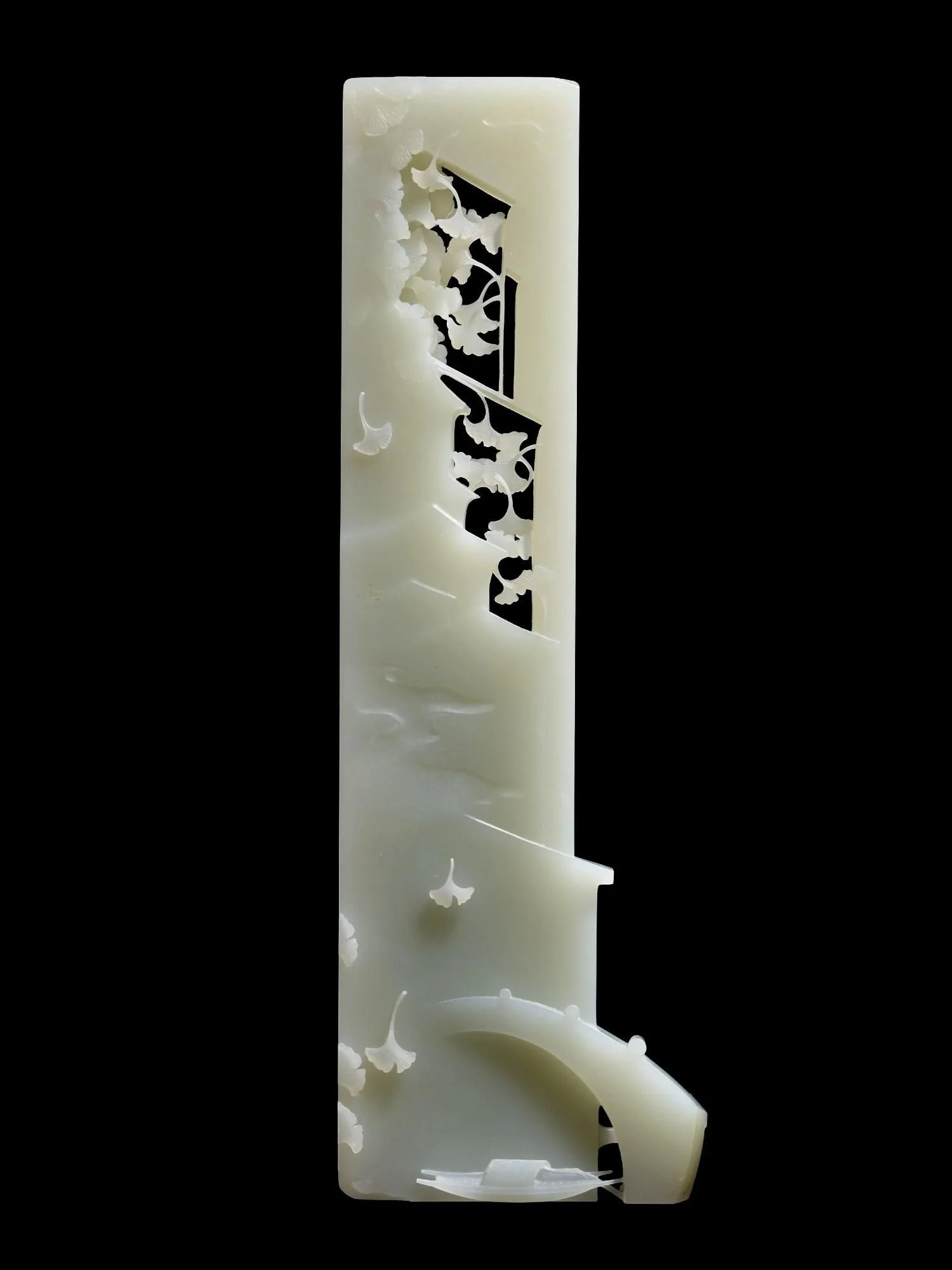
British Museum: Autumn in Suzhou, by Yang Xi, made of Chinese jade. Walking through the Cartier exhibit or a jeweller’s atelier, you will also see the stark contrast between eastern and western gemstones.
When compared against the crown jewel of Cartier’s craftsmanship: the Tutti Frutti collection, once again we see this difference in aesthetic values. The west, infatuated with brightness and explosion of ornament perhaps has never considered the richness and quiet dignity that lies in shadow.
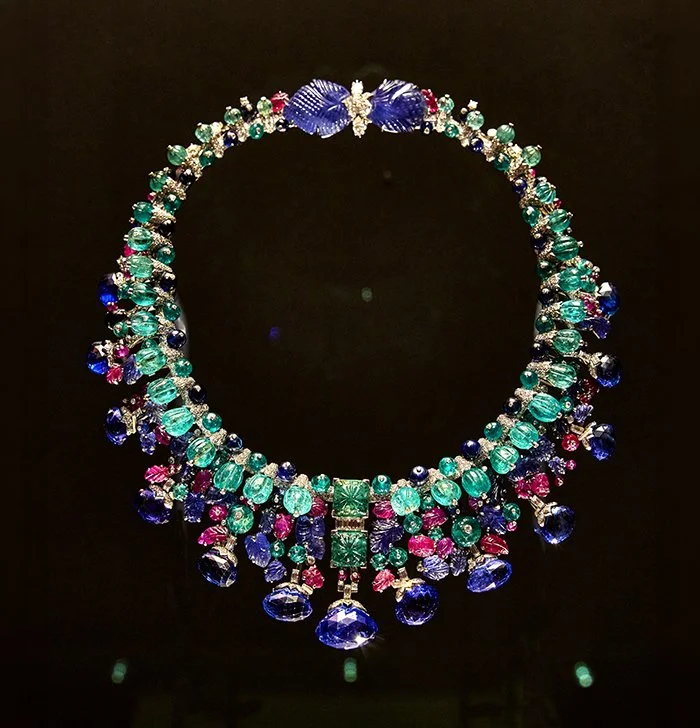
Cartier Collection. Photograph: Vincet Wulveryck. Cover picture of Hermes AW26 by Max Farago
The night is indeed a beautiful thing. There is so much beauty that can be found in and embody the yin. However, life is most beautiful when we find balance between the yin and the yang, as the ancient symbol of the tai chi represents. It is the role of humanity, of artists, of people who wish to live well to find this balance in life.
Our role as a feng shui consultant is to help design a life of balance for you, mostly through informing on your environment, but know that these changes ripple out into the body, mind and soul. Tonight I implore you to develop your own praise of shadows, to appreciate the yin of your life.
If you would like your life to embody more balance, or if you want your environment to support, nourish and allow yourself to rest, consulting with Angelign can be a pivotal step in moving toward a happy, healthy life of ease clarity and wellbeing.
You are welcome to find out more about our feng shui, sound healing/ spatial wellbeing or property services through the Angelign website (www.angelign.com) or email me an enquiry about your space (contact@angelign.com)
With love and alignment,
A
One of my favourite passages of this novel, where Tanizaki talks about the beauty that can only be seen in shadow. Specifically, the spiritual sites of Japan. The Buddha painted in gold foil or the venerable man adorned with threads of gold and silver looks gaudy in full yang. It is only when in the world of the ancients; in spaces that embraced the yin, that their beauty fully known.
